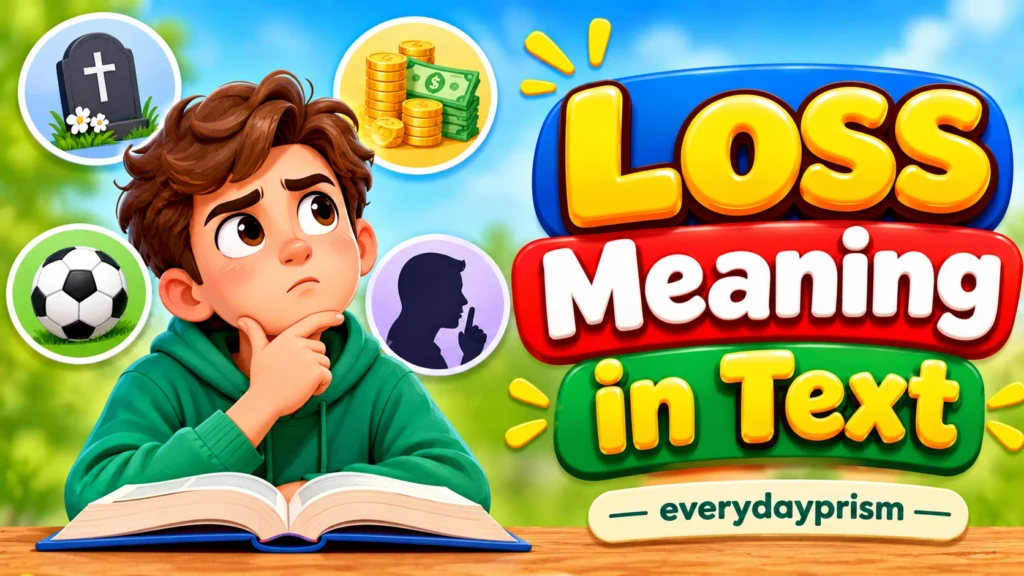
Loss meaning in text is the absence a message points at: a person who has died, money spent beyond earnings, a game not won, or a thing gone missing. The words around loss say which one it is, and this guide sorts the senses — death, money, sport, function, and the at-a-loss idiom — so any single message can be settled in seconds.
Readers usually arrive with one message and one worry: serious, or everyday? This guide sorts the word’s shapes — dictionaries, prepositions, history, idioms — so the loss meaning in text in any single message can be settled in seconds.
One Absence Many Shapes and What the Dictionaries Agree On
Dictionaries split the word differently but agree on the centre. Merriam-Webster lists seven senses, from destruction and ruin through inability to keep something, loss of a physical capability, failure to gain or win, and decrease. Oxford’s Advanced Learner’s Dictionary keeps five: no longer having something, money lost by a business, a death, the disadvantage of someone leaving, failure to win a contest.
Collins adds a sense the others fold away: loss as the feeling itself, the sadness felt when someone or something liked is taken away. Longman agrees, with a sense for the sad or lonely feeling when someone or something is no longer there. That feeling sense matters for messages: a sender who writes of a sense of loss may name grief rather than any single event. The loss meaning in text in a short message is often that feeling, details unsaid.
Dictionaries split the word differently, but the loss meaning in text in a short message is often the feeling sense — grief or absence with details unsaid.
One more split helps: loss can name the thing gone, the event, or the harm left. Dictionary.com lists all three — something lost, the act of losing, and the detriment or privation caused by losing. “The loss of the contract” can mean the contract itself, the moment it slipped away, or the damage that followed; the verbs — suffered, reported, mourned — say which.
Of To and At the Three Small Words That Sort the Sense
Three little words do most of the sorting, and checking them settles the loss meaning in text faster than a definition. Of names what is gone. To names who is worse off. At, in at a loss, names either a price or a puzzle. Read the preposition first.
Checking the preposition first settles the loss meaning in text faster than any definition: of names what is gone, to names who is worse off.
| Pattern | What it names | Example shape |
|---|---|---|
| loss of + thing | What is gone or reduced | loss of power, loss of appetite |
| loss of + person | A death, or someone gone | loss of a friend, loss of a colleague |
| a loss to + person or place | Who is worse off | a loss to the school |
| losses (plural) | Several cases, or the dead | job losses, net losses, heavy losses |
| at a loss | Selling below cost, or not knowing | operating at a loss; at a loss for words |
The of-pattern carries the most weight: the noun after of does the naming — loss of signal, loss of earnings, loss of control, loss of a loved one. Of plus a person usually means a death or departure; of plus a thing or function means absence or reduction. Weight loss and hair loss drop the of, but the pattern is the same: the word before loss names what is getting smaller.
In money messages where one payment changes everything, a single amount can turn a profit into a loss.
The to-pattern points the other way, at the people left behind: “a loss to the department” says the department is worse off, in Cambridge’s Learner’s Dictionary shape. The plural needs care: job losses are countable cases; heavy losses in a war report means soldiers killed, wounded, or captured; loss of life means deaths, usually many. Nearby number words — 200, several, heavy — mark which plural is meant, and the loss meaning in text in a news report usually turns on them.
From Destruction to a Score Line and the Words Long Softening
Loss began as a harder word. Oxford traces it to Old English los, “destruction”, related to Old Norse los, the breaking up of an army’s ranks, and to loose. The modern noun probably grew as a back-formation from lost, the past participle of lose, with the “probably” kept by both Oxford and Merriam-Webster.
The dates differ because each source dates a different stage: Merriam-Webster records first known English use in the 13th century, in the destruction sense; Collins places the noun in the 14th century; Dictionary.com records the Old English form before 900. Etymonline follows the verb lose from Old English losian, “be lost, perish”, through a Germanic root meaning to loosen, divide, and cut apart — the root of loose, the suffix -less, and forlorn. The loss meaning in text still carries that old sense of something coming apart.
The softening took centuries. Etymonline dates “part with accidentally” to around 1200, “fail to gain or win” to around 1300, and intransitive “fail to win” to the late 14th century. A word that once meant ruin now covers a missed bus, a diet, and a score. Oxford gives the pronunciation /lɒs/ for British English and /lɔːs/ for American English.
The Idiom Family
Loss travels in fixed company, and the phrases around it often matter more than the word alone. The loss meaning in text inside an idiom is the phrase’s meaning, not the noun’s. The family below covers the phrases met most in messages.
Inside an idiom the loss meaning in text is the phrase’s meaning, not the noun’s — at a loss for words names a silence, not a cause.
Fixed phrases can carry a word far from its first sense, like a word that travelled from the stage to the insult shelf.
At a Loss in Two Ways
At a loss has two jobs that share nothing but the words: bewilderment — Oxford gives “not knowing what to say or do”, Cambridge’s Learner’s Dictionary “to not know what to do or say”, with the pattern at a loss to explain — and money, selling below cost, as in “operating at a loss”. Dictionary.com lists both; the topic decides: a confused reply or a set of accounts.
The commonest form in messages adds for words: at a loss for words means unable to think of anything to say. It follows good news and bad alike, because it names the silence, not the cause. A longer cousin, at a loss to explain, keeps the bewilderment with the puzzle named. When a message says “I am at a loss”, the next words settle it: money or confusion.
Cut Your Losses Loss of Face and Newer Phrases
Cut your losses means stopping a failing activity before it costs more — Oxford gives stopping something unsuccessful before the situation becomes worse. It suits money, projects, and arguments alike, and always looks forward: the loss already happened; the point is to stop adding to it. That’s his loss works the other way: someone missed a benefit by refusing an opportunity, and Longman marks it as spoken.
Loss of face means being less respected, or looking foolish, after something done — Oxford’s idiom entry, about reputation, not anything misplaced. Reverso’s expressions list adds a loss leader, a product sold at a loss to attract customers, and a paper loss, a decrease in value not yet realised by a sale. A dead loss, in the same list, is something or someone completely useless or unsuccessful.
8 Messages and 8 Readings
The 8 messages below show the loss meaning in text across condolence, money, sport, and everyday chat, with a note naming each sense. All eight are invented.
Answering a Loss Message and What Fits and What Does Not
Replies go wrong when the sense is guessed instead of checked, and the cost is highest after a death. The loss meaning in text in a condolence thread calls for short, plain wording — “sorry for your loss”, “thinking of you”, an offer of help — no questions about causes, no advice. The vagueness of “your loss” is deliberate: it lets the receiver decide how much to share, so asking for details breaks the kindness the phrase offers. This guide explains wording only; it offers no grief counselling.
Matching the reply to the sense is the whole skill: the loss meaning in text in a condolence thread calls for short plain wording and no questions about causes.
Money and sport messages want a different reply. A business loss gets acknowledgement and a forward look; a game loss gets sympathy for the effort, not analysis of the defeat. “Better luck next time” fits a game and nothing else; aimed at a bereavement or a redundancy it sounds careless. Match the reply to the sense; when the sense is unclear, ask one short question first.
One boundary matters most. “Sorry for your loss” belongs to serious news, above all a death, and can stretch to other grave news such as losing a home. Used for a lost game, a broken phone, or a missed bus, it promises sympathy the situation does not need. For small setbacks, plain words fit better — “tough luck”, “what a shame”, “oh no” — and checking the loss meaning in text first keeps sympathy in proportion.
Loss Beside Its Neighbours
Near words overlap with loss, but each leans a different way, and pinning down the loss meaning in text often means ruling neighbours out. The table sets the closest words beside the sense each one serves.
Ruling neighbours out pins the loss meaning in text down: defeat fits a contest, bereavement fits a death, deficit fits accounts — and none of them fits all three.
| Word | What it names | Where it fails |
|---|---|---|
| Defeat | A contest not won | Money, health, or a death |
| Bereavement | Grief after a death | A game, a business, a misplaced thing |
| Deficit / shortfall | Money missing from accounts | A death, a defeat, a feeling |
| Deprivation | Being kept from something | A defeat or a sale below cost |
| Absence | Simply not being there | The harm or grief loss carries |
| Waste | Poor use of time or resources | A death, a defeat, a loved one |
The opposites test the sense from the other side, and they change with the meaning: gain and profit against money loss, win and victory against a defeat, found against a misplaced thing. Dictionary.com lists gain as the antonym of its first sense; Oxford gives profit as the opposite of the business sense. Setback sits nearby, a defeat that slows progress without ending it — softer than loss for a contest, no substitute after a death. If none of the opposites fits, the reading is probably wrong; the preposition test is the fastest way back.
Frequently Asked Questions
A death or bereavement; “sorry for your loss” is the standard condolence, and its vagueness is deliberate.
A business spent more than it earned, or an investment fell in value; “operating at a loss” means selling below cost.
A game or contest the team did not win; “a 2-1 loss away from home” is a defeat, not a tragedy.
Either not knowing what to say or do, or selling below cost; “at a loss for words” is the commonest message form.
Stop a failing activity before it costs more; it looks forward, not back.
Bereavement is grief after a death; loss is the wider word, covering deaths, money, defeats, and missing things.
Being less respected, or looking foolish, after something done — about reputation, not anything misplaced.
No; it belongs to serious news, above all a death. For small setbacks use “tough luck” or “what a shame”.
Conclusion
Loss has a steady core: something or someone no longer there — a death in a condolence, money spent beyond earnings in accounts, a defeat in sport, a capability reduced in the body, a silence in the idiom. The loss meaning in text becomes clear once the preposition, topic, and tone are checked together.
Read the words around loss, and ask a short question when two senses fit. Then loss is a clear signal of what is missing, and what kind of missing it is.