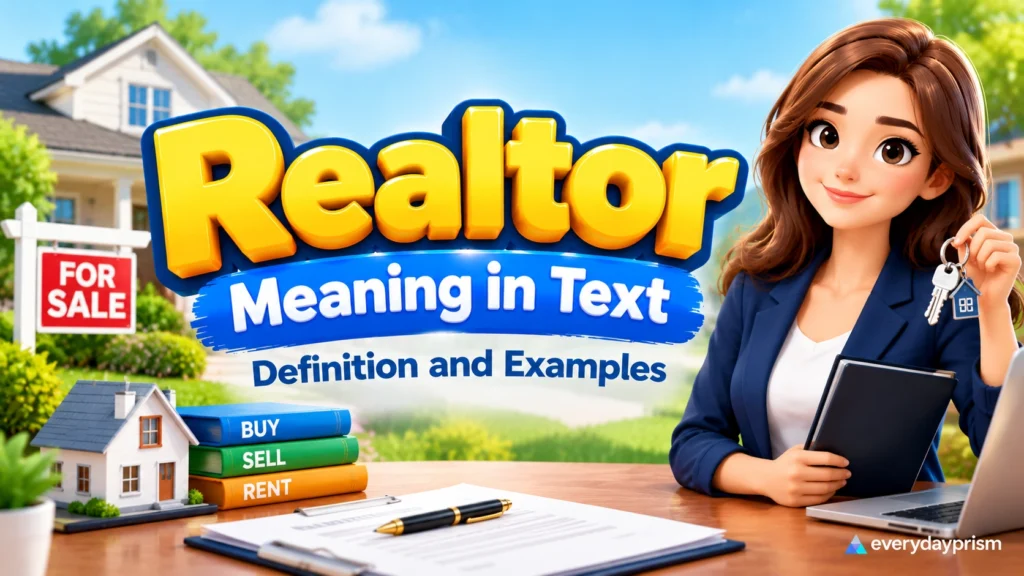
A message that mentions a realtor is usually about a move: a viewing, an offer, a set of keys. The realtor meaning in text starts with that picture — a person who helps others buy, sell, or rent homes and land. But the word carries a second layer: in formal writing, the capital R claims membership, not just a job.
This guide separates the two layers, from the capital letter to the word’s invention in 1916, and shows how to read any single message — from a business card to a group chat. By the end, the realtor meaning in text should take seconds to settle: check the spelling, the sender, and the topic.
The Capital R That Changes the Claim
Realtor is unusual among job words because it began as a badge, not a description. The National Association of Realtors owns the word as a registered trademark — a collective mark — in the United States, and its own materials write it as REALTOR with the registered symbol. A signature, card, or ad using the capital R claims membership, checkable in the directory. That is the first fork in the realtor meaning in text: a capital R usually signals the title, a lowercase r the job.
The distinction is about membership, not skill. A Realtor and a non-member agent hold the same state license and do the same daily work. Membership adds dues, a code of ethics, and ethics training every three years — no higher license, no guarantee of results.
What the Style Books Say
Style guides agree on the capital letter. The Associated Press Stylebook capitalizes Realtor but recommends real estate agent unless membership needs showing; The New York Times manual and a government style manual agree, and always capitalize it.
Dictionaries are split in a revealing way. Merriam-Webster and American Heritage capitalize the term, while the Oxford English Dictionary lowercases it, calling it a proprietary name with an extended general use. Garner’s Modern English Usage notes few people know about the trademark, so the word is used indiscriminately for agents generally. In a careful publication the capital R means something; in a casual text it often means nothing.
A Word Invented in 1916
Unlike most job titles, realtor has a known birthday and inventor. Charles N. Chadbourn, a Minneapolis real estate agent, coined it in 1916 from real — as in real estate — plus the agent ending -or, on the model of Latin agent nouns such as actor and creator. Wiktionary and Oxford both record the construction as realty plus -or. Chadbourn wanted a distinct title separating members from the trade’s less scrupulous end.
The association moved fast. Chadbourn suggested the term in January 1916, a members’ bulletin called The Realtor carried it into print on February 27, 1916, and the national convention adopted it the same year for active members. The resolution limited the word to members in good standing under the Code of Ethics, instituted in 1913. The table gives the dates that matter for the realtor meaning in text.
| Year | What happened |
|---|---|
| 1913 | The association institutes its Code of Ethics |
| 1916 | Chadbourn coins it; the convention adopts it for members |
| 1920 | A Minnesota court rules the word belongs to the association |
| 1922 | Sinclair Lewis makes Babbitt the icon of an era |
| 1948–1950 | Lanham Act rules allow collective marks; registrations follow |
The 1920 court case shows the association guarding the word: a directory publisher had used realtor indiscriminately, and the District Court of Hennepin County ruled for the association, saying the word had never been used until it was invented. Sixteen local and state cases went the same way before federal rules changed.
What the Dictionaries Record
The dictionaries agree on the centre and differ at the edges, and the realtor meaning in text sits in that agreement. Cambridge labels the word a US trademark: a person whose job is to arrange the sale, renting, or management of homes, land, and buildings for their owners, and who belongs to the National Association of Realtors. Its Business English entry adds work for a real estate agency in the United States.
Oxford is shorter: one sense — a person whose job is to sell houses and land for people — with real estate agent the North American equivalent and estate agent the British one. Merriam-Webster adds the legal label: a collective mark, a trademark relating to a group of people rather than a product, used for an agent who belongs to the association. Cornell’s legal dictionary agrees: a Realtor can be an agent or a broker, but an agent or broker is not necessarily a Realtor.
Wiktionary widens the frame to Canada and businesses: a person or business selling or leasing real estate as agent for the owner. No major dictionary records a slang or texting-only sense.
Three Labels That Are Not Interchangeable
Three labels do most of the confusing in property messages: Realtor, real estate agent, and broker — a membership, a license, and a higher license. The realtor meaning in text is clearest when they are kept apart, so the table sets them beside the two other words readers meet most.
| Word | What it describes | The test in a message |
|---|---|---|
| Realtor | Membership in the association | Capital R, REALTOR, NAR, Code of Ethics |
| Real estate agent | State license to help buy, sell, rent | License, listings, viewings, offers |
| Broker | Higher license; runs a brokerage, supervises agents | Brokerage, supervising, office owner |
| Estate agent | Standard British term for the same job | UK spelling, UK setting, no trademark |
| Property manager | Day-to-day care of rented property | Repairs, tenants, rent collection |
The association’s summary is the cleanest statement: all Realtors are licensed, but not all licensed agents are Realtors. Membership is voluntary and separate from the license, gained by joining a local association and paying dues. A broker who joins can also be a Realtor, but broker in a message usually signals the person in charge.
The Sentence That Separates Them
One sentence settles most cases: ask whether the message claims a license, a membership, or a rank. A license claim points to real estate agent, a membership claim to Realtor, a rank claim to broker. When a message says only “our realtor”, with no capital R and no association words nearby, the safest reading is the general one — the agent handling the move — because the realtor meaning in text in casual writing rarely carries the membership claim.
Say It Right: Two Syllables, First-Syllable Stress
Realtor is pronounced REE-ul-ter, two syllables with the stress on the first syllable — the accent Chadbourn himself specified. Cambridge gives /ˈrɪəl.tər/ for British English and /ˈriː.əl.tɔːr/ for American English, and Oxford gives /ˈriːəltə(r)/. Merriam-Webster warns against the three-syllable REE-luh-ter, an extra syllable between the l and the t that many listeners object to, and Wiktionary labels that form proscribed.
Spelling follows the capital-letter rule: REALTOR with the registered symbol officially, Realtor with a capital R in dictionaries, lowercase realtor for the general job word. The plural is realtors in all three forms, and the word is a noun only: no verb “to realtor”, and realty names the business or property, never a person. When the spelling is checked, the realtor meaning in text usually follows.
8 Messages, 8 Readings
The 8 messages below show the realtor meaning in text across cards, chats, listings, and headlines. Each note names the sense and clue. All eight are invented, with no real people.
Reading the Sender, Not Just the Word
The same spelling means different things from different senders, and the realtor meaning in text is often settled by asking who wrote the message. A signature block, card, or ad is the formal end: the capital R is a deliberate claim, verifiable in the directory. A friend’s text sits at the other end: “my realtor” means the person helping with the move, and nobody is checking membership.
Listings sit in the middle: “contact the realtor for a viewing” uses the word as a role label for whoever holds the listing, and the reader’s job is to book the viewing, not verify a title. Headlines sit further toward the generic end: what “realtors” expect is the trade talking, and style guides would prefer “real estate agents” unless membership is the story. The sender’s purpose — selling, informing, chatting — is the fastest clue after the capital letter.
When signals mix, topic words decide: membership and ethics point to the title, viewing and keys to the job. This guide explains wording only and is not legal or property advice.
The Same Job in Other Words
Outside the United States the word changes, and the realtor meaning in text in a message from abroad is usually the local term doing the same job. Cambridge gives estate agent as the British equivalent; Wiktionary marks the sense as Canadian and American; and a Canadian glossary defines a realtor as a broker or associate holding active board membership.
| Place | Usual word | Note for readers |
|---|---|---|
| United States | Realtor / real estate agent | Capital R claims association membership |
| Canada | Realtor | Tied to real estate board membership |
| United Kingdom | Estate agent | No trademark restriction on the term |
| Other languages | Makler, agent immobilier, agente inmobiliario | Local words for the same job; no NAR link |
When a message crosses borders, translate the role, not the title. A British estate agent and an American realtor usually do the same work; the difference is wording, not duties. A membership claim does not travel: the capital R means something specific in the United States and Canada, and nowhere else is it a guarantee.
Frequently Asked Questions
In most messages it means the property agent handling a move, a viewing, or a sale. In formal writing with a capital R, it means a member of the National Association of Realtors. Check capitalization, sender, and topic words.
No. Every Realtor holds a license, but membership is voluntary and separate from the license. An agent who has not joined, or whose membership lapsed, should not use the title professionally, though casual texts rarely observe the distinction.
Broker is a license level: extra education and experience, able to run a brokerage and supervise agents. Realtor is a membership: an agent or broker who has joined the association. One person can hold both.
The job is the same, but the word changes: the standard British term is estate agent, with no trademark restriction. A UK message saying estate agent usually describes the same role as an American message saying realtor.
REE-ul-ter, two syllables, stress on the first. The three-syllable REE-luh-ter is widely objected to and labelled proscribed in Wiktionary.
A Title, a Job, and a Clue in the Capital Letter
Realtor began as an invented badge for members and grew into the everyday American word for a property agent; both lives survive today. The realtor meaning in text becomes clear once spelling, sender, and topic are checked together: a capital R in formal writing claims a membership, a lowercase r in a chat names a job.
Read the words around realtor before deciding, and ask when title and job point in different directions.
For more word guides, read our explanation of termagant meaning in text and our guide to lump sum meaning in text. The Cambridge Dictionary entry for realtor gives the dictionary definition, the trademark label, and the US and UK equivalents.