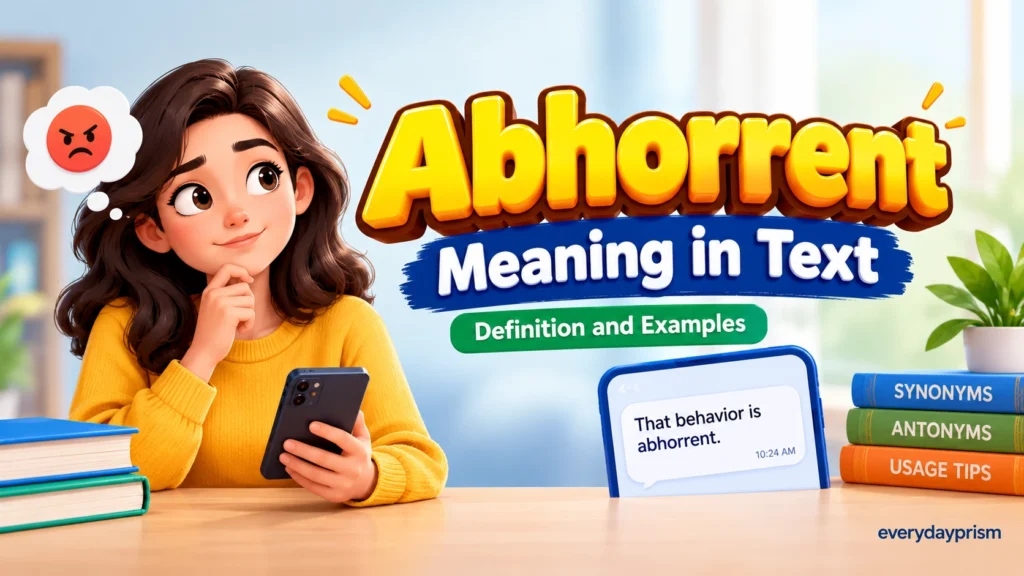
Abhorrent is not a word for ordinary complaints. When a sender calls something abhorrent, they are doing more than saying it is bad: they are passing judgment, claiming that the thing deserves hatred or disgust. The abhorrent meaning in text is a judgment before it is a description, and that is why the word lands so hard.
Readers who look up the abhorrent meaning in text usually have one message in front of them and one question: is this serious, or is it exaggeration? This guide answers by calibrating the word’s strength — the dictionary record, the word’s history, its patterns, and its near words — so any single message can be read in seconds.
The Strength Question: Why “Very Bad” Is Not Enough
Dictionaries agree on the centre and differ at the edges. Merriam-Webster gives three senses: causing or deserving strong dislike or hatred, so repugnant as to stir up positive antagonism; not agreeable, or contrary; and feeling or showing strong dislike or hatred, with the strongly-opposed sense marked archaic. The first sense does nearly all the work, and the abhorrent meaning in text in a serious message is almost always that one.
Oxford’s Advanced Learner’s Dictionary keeps a single sense and a warning label: formal, causing a strong feeling of hate, especially for moral reasons, with repugnant as the synonym. Cambridge’s Learner’s Dictionary also marks the word formal. The formality is part of the meaning: abhorrent belongs to statements and reports more than to quick chat, and a sender who reaches for it wants the judgment to sound grave.
That shared-judgment claim is what separates abhorrent from merely bad. Awful can describe weather, luck, or a headache without blaming anyone. Abhorrent points at something and says it deserves hatred — usually because it breaks a moral rule the sender expects others to share. When the topic cannot carry that claim, the word overshoots into melodrama.
Shrinking Back: The Shudder Inside the Word
The word carries a physical picture. It comes from Latin abhorrere, to shrink back from, to shudder at, built from ab-, away from, and horrere, to shudder or bristle. Oxford’s word-origin note gives the same chain: late 16th century, from Latin abhorrent-, shuddering away from in horror. The same root gives horror, horrible, and horrify — the whole family describes the body recoiling.
The history explains the word’s double life. Etymonline dates the recoiling, strongly-opposed sense to the 1610s, from Latin abhorrens, incongruous or inappropriate, and the repugnant, loathsome sense to the 1650s. Merriam-Webster records the first known English use in 1599, in the older strongly-opposed sense. In Latin the verb was milder: to be remote from, to differ, to be out of harmony with. That milder, older sense survives in the abhorrent meaning in text whenever the word means contrary to a belief rather than hateful.
The verb abhor is older than the adjective. Etymonline dates abhor to around 1400, meaning to loathe or regard with repugnance, literally to shrink back with horror or dread. The adjective grew from the verb’s present participle: a recoil, then a judgment.
The Family Around the Word: Abhor, Abhorrence, Abhorrently
Four forms do the work, and mixing them up is the most common slip. Abhor is the verb: to hate something very much, especially for moral reasons, Oxford’s synonyms being detest and loathe. Its forms double the r: abhors, abhorring, abhorred. Oxford notes it is not used in the progressive tenses, so the plain present does the job. The abhorrent meaning in text is clearest when the verb and the adjective are kept apart: abhor names the feeling, abhorrent names the thing that deserves it.
Abhorrence is the noun, the feeling itself: a strong feeling of hate or disgust. Abhorrently is the adverb, listed by Merriam-Webster as a form of the adjective, but it is rare and usually sounds stiff; most writers reach for “utterly abhorrent” instead. The trap form is abhorred, the past tense of the verb: “the practice was abhorred” means people hated it, while “the practice was abhorrent” means it deserved hatred. One reports a feeling; the other passes judgment.
Three Jobs in Messages
Most messages use the word in one of three jobs. The table names each job and its clues, so the abhorrent meaning in text can be sorted at a glance.
| Job | What the sender means | Clues nearby |
|---|---|---|
| Moral condemnation | An act or idea judged deeply wrong | behaviour, conduct, treatment, acts; absolutely, utterly |
| Physical disgust | Something that stirs revulsion of the senses | smell, sight, taste; foul, revolting |
| Contrary to values | Something clashing with beliefs or principles | abhorrent to, beliefs, values, philosophy |
The moral job is the most common in serious writing. Wiktionary’s usage notes list the nouns abhorrent is most often applied to: behaviour, act, crime, practice, thing — all words for conduct, not objects. Conduct points to judgment; a smell points to revulsion. The topic is the fastest clue.
The contrary-to-values job is the oldest and the quietest. It survives in the phrase abhorrent to, where the word means out of harmony with rather than hateful: a notion abhorrent to a philosophy, a practice abhorrent to a profession’s code.
The “Abhorrent To” Pattern: The Object Names the Standard
The most useful pattern in the whole word is two words long: abhorrent to. The object after to names the standard being invoked, and reading that object settles the abhorrent meaning in text faster than any definition. “Abhorrent to me” is personal feeling. “Abhorrent to any fair-minded person” claims a shared standard. “Abhorrent to our values” points to a code or creed.
Oxford’s collocations back this up: the verbs be, become, and find something, the adverbs absolutely, totally, and utterly, and the single preposition to. Wiktionary adds an older distinction worth knowing: in the opposed sense, abhorrent was typically followed by from, while in the contrary sense it is followed by to. Modern messages use to; from survives only in older writing.
Absolutely, totally, and utterly signal the full-strength sense, with the judgment on record. A bare abhorrent, with no intensifier and a trivial topic, may be either serious or joking — the thread has to decide.
The Strength Ladder: Where Abhorrent Sits
Abhorrent sits at the far end of a scale, and placing it on that scale prevents most misreadings. The ladder runs from mild to extreme, with the claim each word makes. The abhorrent meaning in text is the top rung: not just bad, but deserving hatred.
| Word | Strength | What it claims |
|---|---|---|
| Unpleasant | Mild | Not liked; no judgment |
| Awful | Moderate | Very bad; often just terrible |
| Appalling | Strong | Shocking; dismay at what was found |
| Abhorrent | Extreme | Deserving hatred; a moral claim |
The near words each lean a different way. Appalling stresses shock: appalling conditions may horrify without deserving hatred. Atrocious stresses cruelty or poor quality, and horrific stresses fear — both describe the thing, while abhorrent judges it. Abominable is the closest match in moral force, though it is also used loosely for very unpleasant things such as weather. Repugnant stresses aversion, detestable stresses deserving hatred, odious stresses being hateful to others, and loathsome stresses disgust.
The opposites test the sense from the other side: commendable, admirable, and praiseworthy for moral repulsion; pleasant and delightful for sensory disgust; acceptable for unacceptable. If none fits the message, the reading is probably wrong.
8 Messages, 8 Readings
The 8 messages below are ordered from strongest to weakest, so the abhorrent meaning in text can be felt as a scale. Each note names the job and the clue. All eight are invented, with no real people.
When the Word Overshoots: Register, Jokes, and Targets
The word’s strength is also its risk. Usage guides warn against the same two mistakes: overusing abhorrent until it loses force, and aiming it at minor annoyances so the message sounds melodramatic. A late bus, a cold coffee, or a long queue cannot support a claim of moral hatred, and the abhorrent meaning in text in a straight message about such things reads as overstatement, not conviction.
Joking use works only when the joke is obvious: laughing emojis, a self-mocking tone, or a plainly trivial topic signal exaggeration. Without those signals, a joking abhorrent reads as genuine anger. The humour comes from the gap between the grand word and the small complaint.
The target matters as much as the topic. Calling behaviour abhorrent condemns an act; calling a person abhorrent condemns the whole person, and the insult lands hard. Aimed at a real person, that wording usually ends a conversation rather than improving it. Name the act, say what was wrong, and leave the person’s character out of it unless that condemnation is truly intended.
Register helps too. The formal word sounds at home in statements and reports, and slightly stiff in quick chat — which is why it works as deliberate exaggeration there. If the message is formal and full sentences, read it seriously; if it is chatty and the topic is small, check for the joke before answering in kind.
Abhorrent or Aberrant? The Lookalike Test
The lookalike to watch is aberrant, which shares letters and length but no judgment. Aberrant means departing from what is normal or typical: aberrant results in a report, aberrant weather in a forecast. A thing can be aberrant without being wrong, and abhorrent without being unusual. The abhorrent meaning in text turns on hatred; aberrant turns on deviation, and swapping them turns a neutral observation into a condemnation, or a condemnation into a curiosity.
The swap test settles it. If “unusual” fits the sentence, the word meant is aberrant. If “hateful” fits, the word meant is abhorrent. A message praising or neutrally describing something odd points to aberrant; a message condemning something points to abhorrent.
Frequently Asked Questions
In most messages it means something so disgusting or morally wrong that it deserves strong dislike or hatred. Check the topic: conduct points to condemnation, smells to disgust, and trivial topics with a joking tone to exaggeration.
Yes, by a long way. Awful covers anything very bad, from weather to news. Abhorrent claims disgust or hatred, usually with a moral edge, and sounds wrong for ordinary bad luck.
It means something clashes with, or disgusts, the person or standard named after to. “Abhorrent to me” is personal feeling; “Abhorrent to our values” points to a shared code.
The word stays the same, but the claim is not meant. In a joking message, abhorrent dresses a small annoyance in grand language. Look for laughing emojis, self-mockery, or a plainly trivial topic before taking it seriously.
Abhorrent means deserving hatred or disgust; aberrant means departing from the norm, with no judgment attached. An aberrant result is simply unusual; an abhorrent act is condemned.
A Strong Word, Used on Purpose
Abhorrent has kept its force for four centuries because it does one job well: it turns dislike into judgment. The abhorrent meaning in text becomes clear once topic, pattern, and tone are checked together.
Read the words around it before deciding, and ask a short question when the serious and joking senses both fit. Then abhorrent becomes a clear signal of strong feeling, not a puzzle.
For more word guides, read our explanation of termagant meaning in text and our guide to lump sum meaning in text. The Merriam-Webster entry for abhorrent gives the dictionary definition, the senses, and current usage examples.