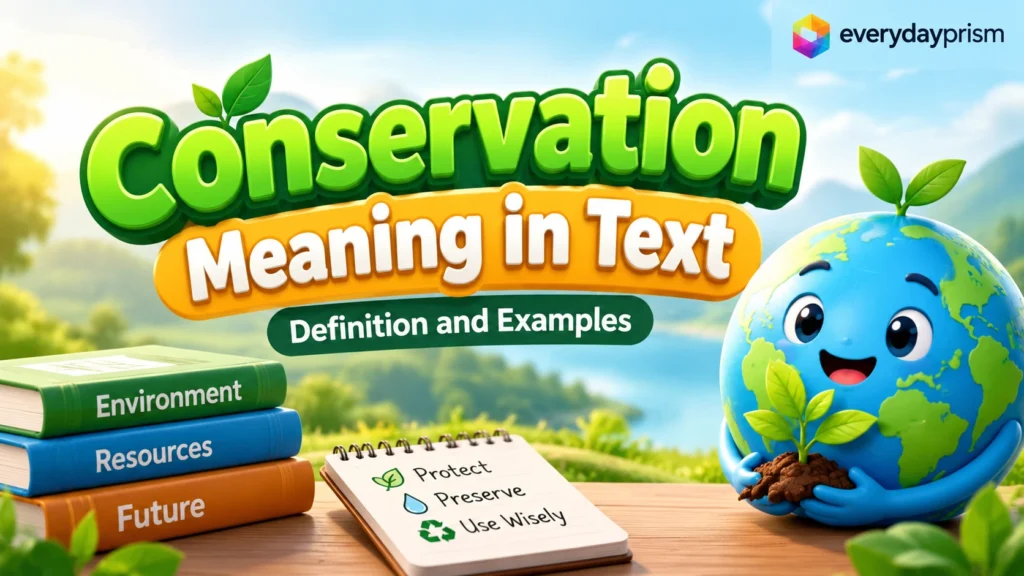
Most readers meet conservation in a headline about a forest, a note about saving water, or a museum label about an old painting. In each place the word does the same job: it names careful protection of something valuable. To pin down the conservation meaning in text, start with that job, then ask what is being protected.
The word is older than the green movement, and it covers more ground than nature alone: wildlife, historic buildings, careful use of energy, and even physics, where it names quantities that stay constant. Read the senses below, and the conservation meaning in text becomes clear in every setting.
What the Dictionaries Say
Merriam-Webster defines conservation as a careful preservation and protection of something, especially the planned management of a natural resource to prevent exploitation, destruction, or neglect. That already explains most cases of the conservation meaning in text: something valuable, plus a plan to keep it safe.
Cambridge Dictionary stresses protection: plants and animals, natural areas, and interesting and important structures and buildings, especially against the damaging effects of human activity. It also records an everyday sense: the careful use of energy, water, and similar resources so they are not wasted. Together, the two dictionaries span the range from a nature reserve to a household bill.
Dictionary.com adds two further senses: official supervision of rivers, forests, and other natural resources, and the careful use of a resource so it is not used up. Conservation is a noun, usually uncountable: the plural appears only in formal writing about separate programmes.
A 14th-Century Word With a Modern Job
Merriam-Webster traces the word to Middle English conservacioun, maintenance in good condition, borrowed from Anglo-French and Latin. The Latin source is conservatio, the action of keeping something intact or unharmed, from the verb conservare, to save or keep from danger. First known English use: the 14th century. That long history is one reason the conservation meaning in text feels settled: the word has meant keeping something safe for centuries.
The Latin verb breaks into con-, together, and servare, to guard or keep. Reference works date the modern environmental sense to the 19th century, when concern grew over deforestation and resource loss; encyclopaedia accounts trace organised conservation efforts in the West to 17th-century attempts to protect European forests. The green sense is young; the word itself is not.
The Word Family: Conserve, Conservationist, Conservancy
Conserve is the verb — Cambridge Dictionary defines it as keeping and protecting something from damage, change, or waste — and it pairs with water, energy, and strength. A conservationist works to protect nature or heritage; a conservancy is an organisation, or sometimes an area, concerned with that protection. Conservatory shares the Latin root but has gone its own way — a glass-walled room for plants, or a school of music — and is not a synonym for conservation.
Four Settings, One Core Idea
The table maps the four settings where the conservation meaning in text most often appears. The core idea never changes — something valuable is kept safe — but what is kept, and how, changes with the setting.
| Setting | What is kept | Clue words |
|---|---|---|
| Nature and wildlife | Forests, water, soil, species, habitats | protect, manage, restore, sustain |
| Heritage and art | Buildings, paintings, documents, objects | repair, preserve, archive, restore |
| Home and work | Energy, water, fuel, materials | save, reduce, reuse, avoid waste |
| Science | Energy, momentum, other quantities | constant, isolated system, law of |
Nature: Planned Care, Not a Locked Gate
In nature writing, conservation means planned care for air, water, soil, plants, animals, and their habitats. National Geographic’s education resource draws the key line: conservation seeks the sustainable use of nature by people — hunting, logging, or mining under rules — while preservation protects nature from human use. National parks are managed for minimal change; national forests allow grazing, timber, hunting, and recreation within limits.
A Spanish research council dossier puts it plainly: conservation is the set of actions people agree on to reduce their impact and leave natural systems able to survive, protecting species, genes, ecosystems, and the processes sustaining life.
Heritage: Keeping the Past Usable
Dictionary.com lists the restoration and preservation of works of art as a full sense, and Merriam-Webster’s examples include the conservation of furniture and religious shrines. In museums and archives, conservation means protecting books, documents, artworks, and historic buildings from decay, and repairing them for future visitors — a label mentioning conservation work usually means specialists cleaning, stabilising, or repairing an object.
Home and Work: Conservation as Careful Use
At home and at work, conservation usually means using less on purpose: switching off what is not needed, choosing efficient options, fixing leaks, and watering at cooler times. This is the sense Cambridge Dictionary labels as not wasting — the careful use of a resource so it is not used up — practical advice that often appears with bills and meters.
Physics: When Nothing Is Lost at All
In a science textbook, the conservation meaning in text flips. Merriam-Webster’s second sense is the preservation of a physical quantity during transformations or reactions: under laws of conservation, quantities such as energy and momentum remain constant within an isolated system. Nobody is protecting anything; the total stays the same while its form changes.
Word order therefore matters: “conservation of energy” names a law of nature, while “energy conservation” names the habit of saving power. The phrases share words but answer different questions, and mixing them up is an easy mistake.
Three Neighbours: Preservation, Restoration, Sustainability
Much confusion around the conservation meaning in text comes from neighbours sharing part of the idea. The table sets out the four closest words, with notes after it on when each fits.
| Word | Core idea | Is use allowed? |
|---|---|---|
| Conservation | Protect and manage with careful use | Yes, within rules |
| Preservation | Keep unchanged, shield from use | Little or none |
| Restoration | Repair damage already done | Work, not use |
| Sustainability | Meet present needs without harming the future | Yes, within limits |
A Pennsylvania land-conservation guide puts the contrast simply: conservation seeks the sustainable use of nature by people, while preservation means protecting nature from human use. Restoration means repair of damage already done, such as replanting a cleared riverbank. Sustainability is the widest of these words: the goal conservation serves, leaving resources for future generations. Stewardship, active and responsible care over time, sits close to all of them.
Three Lookalikes That Mislead Readers
Three other words trouble readers of the conservation meaning in text, each misleading in a different way: spelling, politics, and place names.
Conversation: The Spelling Trap
Conservation and conversation differ by only a few letters and are entirely unrelated: one is about protecting and managing, the other is a talk between people. The quick check is the verb — people have conversations, while people practise conservation. Talking, listening, or a discussion points to conversation; protecting, saving, or managing points to conservation.
Conservatism: A Political Word, Not a Green One
Conservatism shares the Latin root conservare, but it names a political outlook favouring tradition and gradual change, not the protection of nature. Both suggest keeping things as they are, which causes the confusion, but a text about conservatism is about politics, while a text about conservation is about protection and careful management.
Conservation Area: A Place With Rules
Dictionary.com records a further sense: a district, river, or forest under official supervision — the sense behind a conservation area, a place set aside and managed for protection, not an action. It usually names a protected place with rules about what may change, so check whether the sentence describes a location or an activity.
8 Messages That Show Conservation at Work
The 8 messages below show the conservation meaning in text in everyday writing, each followed by a brief note on what the sender most likely means.
Three Questions That Settle the Sense
When the conservation meaning in text still feels unclear, three short questions usually settle it. Ask them in order; the answer normally appears before the third.
What Is Being Kept?
Find the nearby noun: forests, water, wildlife, and soil point to nature; paintings, documents, and old buildings point to heritage; energy, fuel, and materials point to careful use; energy and momentum in a science text point to physics. Answering “conservation of what?” usually settles the sentence.
Who Is Doing the Keeping?
A charity, a council, a museum, or a householder each signals a different kind of care: an officer or a charity means organised work, a householder means daily habits. In physics there is no keeper at all, which is itself a clue: if nobody is protecting anything, the science sense is the likely one.
Is Anything Being Used, or Left Alone?
Use points to conservation; leaving alone points to preservation. A forest open for walking and limited cutting under rules is conserved; a wilderness closed to visitors is preserved. If the sentence is about talking, neither fits, and the word you want is conversation.
Writing With Conservation: Collocations That Sound Natural
Using the word well matters as much as reading it well. The pairings below are the ones dictionaries and reference works show most often, and they keep the conservation meaning in text clear.
| Pairing | What it usually means |
|---|---|
| wildlife conservation | Protecting animals and their habitats |
| water conservation | Using water carefully, avoiding waste |
| energy conservation | Using less power, avoiding waste |
| soil conservation | Protecting soil from erosion and loss |
| conservation area | A district managed for protection |
| conservation efforts | Organised work to protect something |
Two habits help. First, the word is usually uncountable: avoid the plural and say “conservation work” or “conservation efforts” when a countable phrase is needed. Second, use the “conservation of” pattern to name the thing being kept — of wetlands, of forests, of energy — then switch to “this work” or “careful use” instead of repeating the word. For keeping something untouched, choose preservation; for careful use, conservation is the honest word.
Frequently Asked Questions
In most messages it means protecting and managing something valuable so that it lasts. Wildlife, water, and forests point to nature; paintings and old buildings point to heritage; energy points to careful use.
No. Conservation usually allows careful, managed use; preservation leans toward leaving something unchanged and shielded from use. National Geographic contrasts national parks, managed for minimal change, with national forests, usable within rules.
It names a law under which the total energy in an isolated system stays constant while its form changes — different from energy conservation at home, which means saving power by using less.
The core idea stays the same, but the setting changes the sense: on a museum label, conservation means repairing and protecting objects, documents, or artworks for future visitors.
No. Nature is the most common setting, but the word also covers historic buildings, artworks, documents, energy, water, and physics. Check the subject before assuming the green sense.
The Idea to Carry With You
Conservation names a steady habit: keeping something valuable safe, whether a forest, a painting, a litre of water, or a quantity in a physics equation. The conservation meaning in text becomes clear once you name what is being kept, who is keeping it, and whether it is being used or left alone.
Read the words around it, and use the dictionary senses as your anchor. Then conservation becomes a precise signal of care, management, and foresight.
For more word meanings explained in the same plain style, you can read about termagant meaning in text and lump sum meaning in text. For a wider educational overview of conservation itself, see the National Geographic Education resource on conservation.